Inquiry TOR and Call for Evidence
-
Asylum support and accommodation is essentially a public service, contracted to private providers by the UK Home Office through the Asylum Accommodation and Support Contract which sits within a broader framework of legislation and policy which determines access to public goods and services for asylum-seekers.
In April 2020, as the COVID pandemic took hold, over 300 asylum seekers living in independent residential accommodation in communities in Glasgow (sometimes called serviced apartments) were moved into hotels, often remaining there for a prolonged period of time (in some cases up to 11 months). Profound concerns were raised by a number of charities about this move and about the quality and appropriateness of the accommodation and associated support available - including access to financial support, adequate healthcare and nutritious food.
In May 2020 one of the asylum seekers appears to have committed suicide in a hotel. In June, several people, including a police officer, were stabbed in an incident in the Park Inn Hotel. The attacker, who was an asylum seeker, was shot dead by police. A number of calls have been made to the Home Office for a Public Inquiry into the circumstances which led to these incidents.
In the meantime, there remains a need for better understanding of how asylum seekers were moved, accommodated and supported in Glasgow during the pandemic and for lessons to be learned. Against that backdrop, Baroness Helena Kennedy QC has responded to a call from Refugees for Justice to chair an independent, evidence-based inquiry into the issues.
This independent Inquiry will examine asylum support and accommodation during the COVID-19 pandemic in Glasgow. The Inquiry will assess the compatibility of the system with human rights principles and relevant legislation; the effectiveness of safeguarding; and mechanisms for scrutiny and accountability. Through this examination, the Inquiry seeks to provide insight and recommendations that can be used to improve the system of asylum support and accommodation in Glasgow and across the UK.Approach
The Inquiry will be conducted by an independent Panel led by the inquiry Chair and supported by a secretariat. The Inquiry prioritises bringing together lived experience with other, more formal, forms of evidence and expertise. In that context, the Inquiry Panel comprises a mix of individuals with experience of the asylum system and professional experts.
The Inquiry is keen to hear evidence from a broad range of voices and organisations including policy makers, statutory agencies, charities, citizens, employees, as well as those people directly impacted by the asylum support system and accommodation provision. This will be facilitated through this call for evidence and oral evidence sessions.
Principles
In taking forward its work, the Inquiry will hold itself to the following key principles:
· Evidence-based: The Inquiry is an evidential exercise which will draw on a wide range of evidence including academic understanding, practitioner and lived experience to better understand the asylum support and accommodation system in Glasgow and how it functioned during the pandemic.
· Independent and Impartial: The Inquiry is independent of any particular group or interest. The findings and outcome of the Inquiry will be determined solely by the Inquiry Panel and all evidence will be heard impartially.
· Inclusive and Empowering: The Inquiry will support and facilitate the widest range of participants to give evidence and to be heard. This includes citizens who were affected (including service users, staff, volunteers, wider community members), politicians, public bodies, statutory and voluntary service providers. It also seeks to recognise the potential of citizens as change agents.
· Safe and Secure: All witnesses will be given the opportunity to be heard and to submit evidence anonymously and personal information will be treated strictly in line with Data Protection policies and procedures. The Inquiry will also seek to ensure support is available for those impacted by their experiences of the asylum system during the process of engaging with the Inquiry.
· Forward-looking and systems-based: The Inquiry seeks to review the functioning of the system to date and identify ways in which institutions, authorities, local communities, and people with direct experience of the system might come together to co-design and co-deliver a better system.
-
Please see the Phase One report from the Inquiry which provides further background to the following questions to which the Inquiry will be seeking answers.
General questions1. To what extent is it acknowledged and thoroughly understood by all relevant actors that the government cannot delegate its responsibility to protect human rights? And that it is responsible for any policy failures and inadequacy of review and oversight of those duties in practice?
2. What is the rationale for the systemic exclusion of people seeking asylum from the economy and society? Why is the care of asylum seekers in the hands of companies run for profit? What alternative models could provide better safeguarding, care and value for money?
3. ‘Migrant Help, Mears on site Welfare Officers, the Asylum Health Bridging Team, NGOs and the Home Office safeguarding team were all supposed to support asylum seekers both proactively and reactively in hotels and self-contained accommodation, yet they did so in the absence of a framework that joined those efforts and services up and did not have system of proactive needs assessment reviews built in.’ How did it come about that in drawing up extensive contracts and schedules between the Home Office and private providers, and conducting lengthy negotiations before contractual appointments were made, there was no creation of an overarching framework?
4. What changes/recommendations have been implemented as a result of the 55 recommendations in the Home Office preparedness for COVID-19: institutional accommodation report, specifically on an assurance framework for the Safeguarding Board?
5. Why, despite the statement that:
“Hotel accommodation is obviously not the preferred way to accommodate asylum seekers I think that prior to the coronavirus fewer than 1000 people were accommodated in hotels so less than 2% of the total as I said we are looking forward we are looking to unwind the hotel accommodation as quickly as logistics allow.”
are people seeking asylum still being housed in hotels?6. If the Home Office is considering a move to a so-described ‘person-centric’ system, what, if not the person, is currently at the centre of the Home Office’s policy and practice in relation to people seeking asylum?
7. Where are there examples of good practice / learning that could improve provision for people seeking asylum, either within or outside the UK?
8. How would an asylum system differ if the Scottish Government were to be solely responsible for the asylum seekers in its geographical area?
9. What parts of asylum accommodation and support system sit with the local authority (in this context Glasgow) and were they aware of the situation in lockdown and supportive of the moves of asylum seekers from independent accommodation to hotels?
10. What were the safeguarding errors in this situation and what can be done to ensure they are not repeated?
Specific Questions
From homes to hotels: Before the moves
What was the rationale for the decision to move people seeking asylum to hotels early in the first COVID-19 lockdown, and what was the process of consultation to ensure the legal, public health, practical and moral validity of this decision, appears to have a confused and therefore not entirely convincing narrative.
Mears (and the Home Office) have sought to explain or justify these moves from serviced apartments and flat to hotels, or the use of hotels, in the following way:
· Shortage of suitable dispersal accommodation to move people into.
· Serviced apartments were short-term lets and they could not keep them any longer.
· Mears Group state they had no alternative, therefore, but to procure hotel rooms - based on the points above.
· That having everyone in hotels would make it easier for local health workers to access asylum seekers.
· That having this group in hotels would reduce Mears workers and asylum seekers having to make trips from serviced accommodation to get the £37 cash support.
· That the moves were made to create the ‘safest environment for new service users.’In order to determine whether it agrees with the Home Office’s own evaluation that “In the context of a global pandemic and the unprecedented scenarios that this presented the rationale behind moving people who had not previously been assessed as vulnerable from service department to hotel accommodation appears sound” this Inquiry will seek evidence to consider:
1. What was the original rationale for the decision to move people seeking asylum from secure accommodation, where they were living independently or as households, into hotels?
2. Of the 321 people moved, how many were moved from serviced apartments, how many from other forms of independent, residential accommodation and how many were moved into the hotels as they were previously destitute?
3. What costs and benefits were discussed and analysed in making this decision?
4. Who was consulted to create and / or validate this analysis? Specifically, much reference is made to protecting the health of Mears’ staff and their service users. Were local public health officials or experts consulted? How and when were the Scottish Government, relevant Scottish Local Authorities, COSLA Strategic Migration Partnership and Migrant Help involved in discussions and decision making? What were these organisations able to do – or what did they do – in anticipation of the moves?
5. What definition of ‘vulnerability’ was used in the context of the requirement to adjust services for those who are vulnerable? In the context of the so-described ‘living document which is designed to develop and grow through the lifetime of the contracts,’ how did the understanding of ‘vulnerability’ change as evidence came to light as to the differential impacts of COVID-19?
6. Were people who were defined as ‘vulnerable’ placed into the hotels?
7. How and when was the resulting decision communicated to all stakeholders including local NGOs and civil society organisations, the local authority, health care providers and the police?
8. What processes were put in place for ongoing risk assessment as a result of this change in accommodation provision? What contingency plans were made?
9. A similar series of questions applies to the decision to stop financial support with immediate effect when moves took place.
From homes to hotels: The moves
The evidence suggests that Mears provided assurances to the ASH Project and others that appropriate notice would be given for moves and that moves would take place in a way that recognised the COVID-19 health emergency. Other evidence from those who were moved states that notice was as little as 30 minutes, that vans (rather than individual taxis) were used, that masks were not always worn by drivers and officials and that social distancing was not possible.This Inquiry will seek further evidence to consider
1. What explanation was given to Mears staff of the reason for moving people from flats and apartments to hotels?
2. What instructions were given to Mears staff regarding these moves; regarding notice to be given to service users, mental and physical health assessments, health and safety and behaviour towards service users during the move process?
3. What data and reporting was being held and tracked at Migrant Help and how did the support of those in hotels change over the period in question as a result of the experiences of their service users?
In the hotels
Again, there is contradictory evidence on food, WiFi, laundry facilities, provision of basic goods (toiletries, hygiene products) and arrangements for access to health support Statements from those moved make it clear that laundry facilities were initially non-existent, then inadequate; that accessing a GP and other health services was difficult and that the provision and service of food was very poor. In contrast, in a ministerial statement on 29 June 2020, the House of Commons was told:
“Where we have procured additional hotels, we provide full-board accommodation, including laundry services, personal hygiene products and feminine hygiene products. Wrap-around services are also provided, including welfare support, healthcare and access to mental health services. Asylum seekers also have 24-hour-a-day access to assistance via Migrant Help through a freephone number…
…and during the coronavirus epidemic over the last three months or so, of those over 5,000 service users, only two have tested positive for coronavirus, and both, I am pleased to say, have fully recovered. Among those people accommodated in hotels there has not been a single confirmed case of coronavirus. So the steps being taken to safeguard the public, and to safeguard the asylum seekers in particular, have been successful.”
This Inquiry will seek further evidence to consider1. What due diligence was done on the hotels to which people were moved?
2. What due diligence was done on the services provided to people in the hotels?
3. What instructions were given to Mears staff regarding provision of food, services, Covid-testing and other health, safety and wellbeing precautions and provisions at the hotels?
4. What instruction and training was given to hotel management and staff on these matters?
5. How many Covid tests were conducted in the hotels, and over what period, to support the ministerial claim that there was no Covid in the hotels and that the ‘steps taken… were successful’?
6. What progress has been made in revising job descriptions, recruitment and training for hotel staff such that it is realistic to expect them to be ‘able to recognise escalation of mental health issues and know what action to take.’
-
The Inquiry published its first report on 26 June 2022. It aims to publish its final report in November 2022.
-
Interested parties are invited to submit evidence relating to any, or all, of the questions above to the office of the Inquiry at info@asyluminquiryscotland.com.
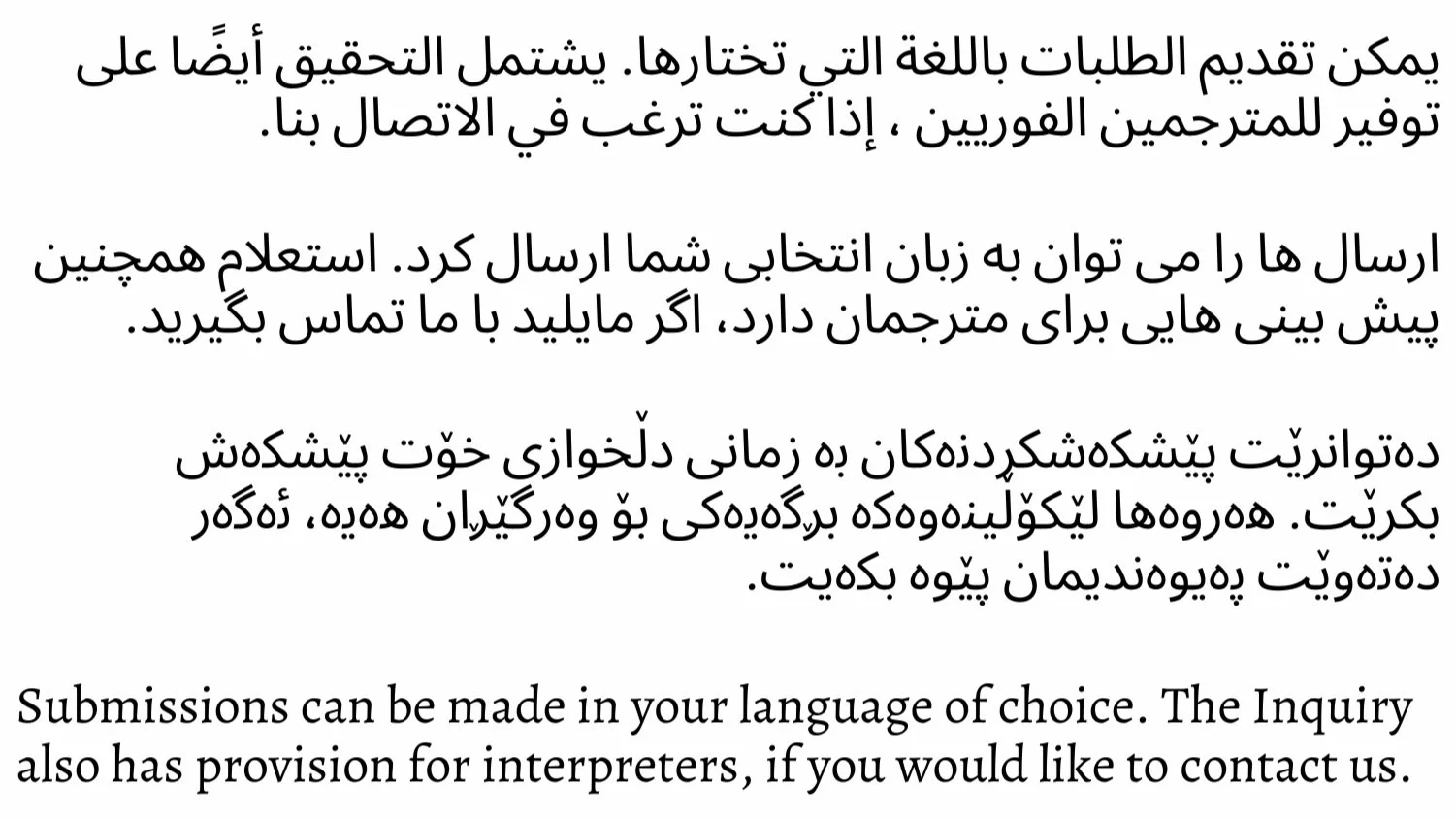
You can also choose to submit your evidence anonymously through the form on this page.
Evidence submissions should be made by 5.30pm on Friday 9 September.Please note that the Phase One report of this Inquiry includes a summary of the existing body of evidence such as was in the public domain in June 2022.
The Inquiry is now seeking evidence that goes beyond what is published in that report.Please include in any submissions:
1. Whether you are willing to be called to provide oral evidence to the Inquiry Panel (in October 2022).
2. Whether you permit for your submission to be published on the Inquiry’s website (https://www.asyluminquiryscotland.com/).
3. Whether you permit quotations from the submission to be used in the Inquiry’s report.
4. Whether any such quotations can be attributed to the provider of evidence, or whether they should be anonymised.
Should you wish to discuss any aspect of any submission, including any requests for confidentiality, with the office of the Inquiry, please contact info@asyluminquiryscotland as soon as possible.